
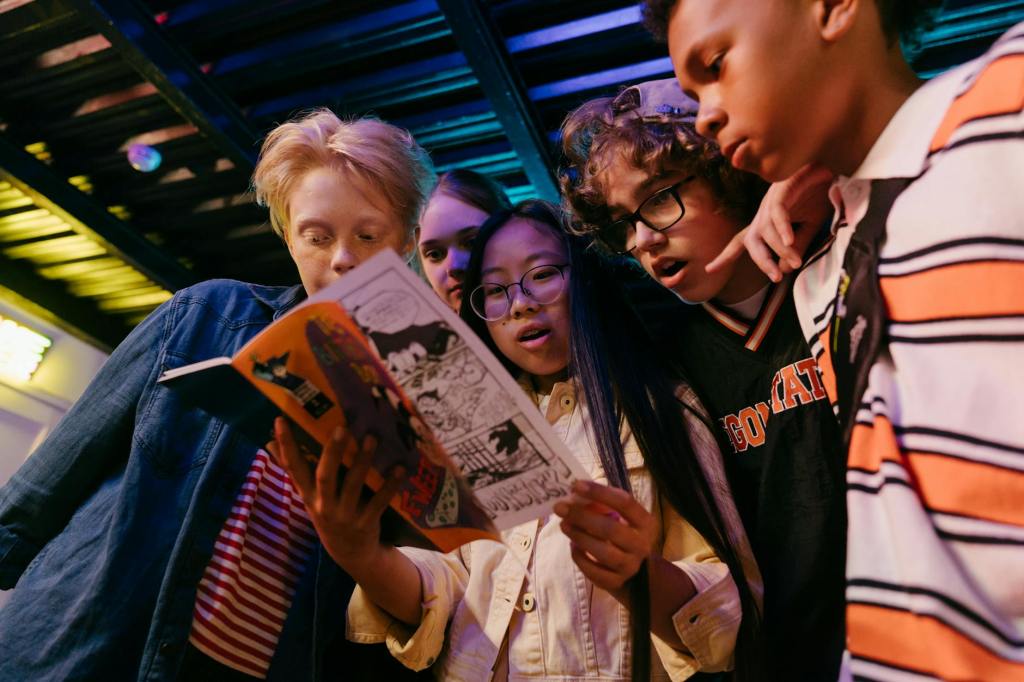
Discussions about comics always involve one of the choices to discuss them either literarily or visually. The ambivalence of this examination area of comics assumes comics as a mere amalgam of certain visual and literary regimes. Comics are considered as the ‘illegitimate child’ or subculture of literature with illustrated stories. The visual regime of comics has never been discussed more seriously beyond the issue of semiotics and representation. In fact, comics can be dismantled and assumed to have their own language!
Linguistics has two recognizable sections. The paradigmatic section discusses the ontology and vertical origin context of the agreement of a language. While the syntagmatic section discusses the inherent horizontal structure in language phenomena. Comics as a language can be identified through this approach, by first identifying the linguistic units of comics.
Comics that are commonly known visually have a coloreme unit in visual language reasoning. This unit, simply put, is what is most eye-catching and summarizes the observed visual field. Coloreme, like phonemes or morphemes, can be grouped into one word, phrase, sentence, or visual paragraph if observed carefully. The determination of this coloreme itself involves the keenness of the viewers’ saccadic eye movements. This saccadic movement becomes a way of understanding and how to read visual language, instead of like written/spoken language which is understood linearly and arbitrarily. Then each coloreme can be bound in its meaning relation triadicly by chopping it up or grouping it into the smallest visual semiotic unit called a lexia.
For comics themselves, since their conception there has been an attempt at definitive reasoning that subtracts or adds every cultural artifact that can be reasoned as ‘comics’. French-speaking scholars themselves classify comics as the ninth art. This reasoning can be traced back to 1845, when Töpffer in Essai de physiognomonie himself showed that sequential visual forms with words were a new and honorable form of literature. Töpffer, who lived in the mid-nineteenth century, argued that the combination of text and images was an inevitable evolution of language and literature. In 1944, György Kepes put forward his thesis on the language of images where every visual always has a plastic organization and visual representation. If visual representation itself is a linguistic nature that imitates or mimes from reality, then plastic organization can be understood as layout, definitive concept reasoning about composition, and juxtaposition/adjacency.
Eisner then specifically wanted to talk about comics by calling it sequential art in 1985. The sequential art that Eisner meant himself involved two regiments, namely the art regiment and the literary regiment. Unlike Töpffer, sequential art a la Eisner requires the gestalt of the two regiments. Regiments with different characteristics are juxtaposed in such a way that they become a new coherent field. This gestalt and coherence was developed by McCloud in 1993, calling comics an invisible art. The meaning of invisible art is the emphasis on the importance of the gutter function between panels as a sequential bridge. This gutter ignites the imagination of the readers, creates a gestalt effect, and produces closure or conclusion. Visually, comics themselves are read by amplifying meaning through simplification of representation in the depiction of symbols.
The syntagmatic section of comics was then formulated by Duncan and Smith in 2009. Duncan and Smith emphasized that for comic language to be understood and coherent, comics must have the following four elements: story, encapsulation, layout, and composition. Encapsulation, in particular, becomes the most important element in wrapping up comic language units. The function of encapsulation itself is framing, chopping, and selecting symbols. This encapsulation then becomes the key to grammar in comic grammar, especially in the sequential nature of comics. Encapsulation then has the goal of ‘subtracting’, so that comics as a medium remain readable additively by involving the reader’s imagination through gestalt and invisible art. The selection of symbols in encapsulation also makes comic language related to its paradigmatic section.
Comics, like other cultural artifacts, continue to evolve and definitively grapple with their position in civilization. Epistemological reasoning and ontological searches about ‘comics’ will never stop as long as people talk about it. However, acknowledging ‘comic language’ as a linguistic regime separate from literary and visual discussions is already a good start. Hopefully this writing can be a good introduction to understanding comic language and further exploring, what exactly is comics?
Further Reading
- Rodolphe Töpffer. Essai de physiognomonie (1845)
- György Kepes. Language of Vision (1944)
- Will Eisner. Comics & Sequential Art (1985)
- Scott McCloud. Understanding Comics (1993)
- Randy Duncan and Matthew J. Smith. The Power of Comics: History, Form, and Culture (2009)

 Kasat Kata Kultur
Leave a comment