

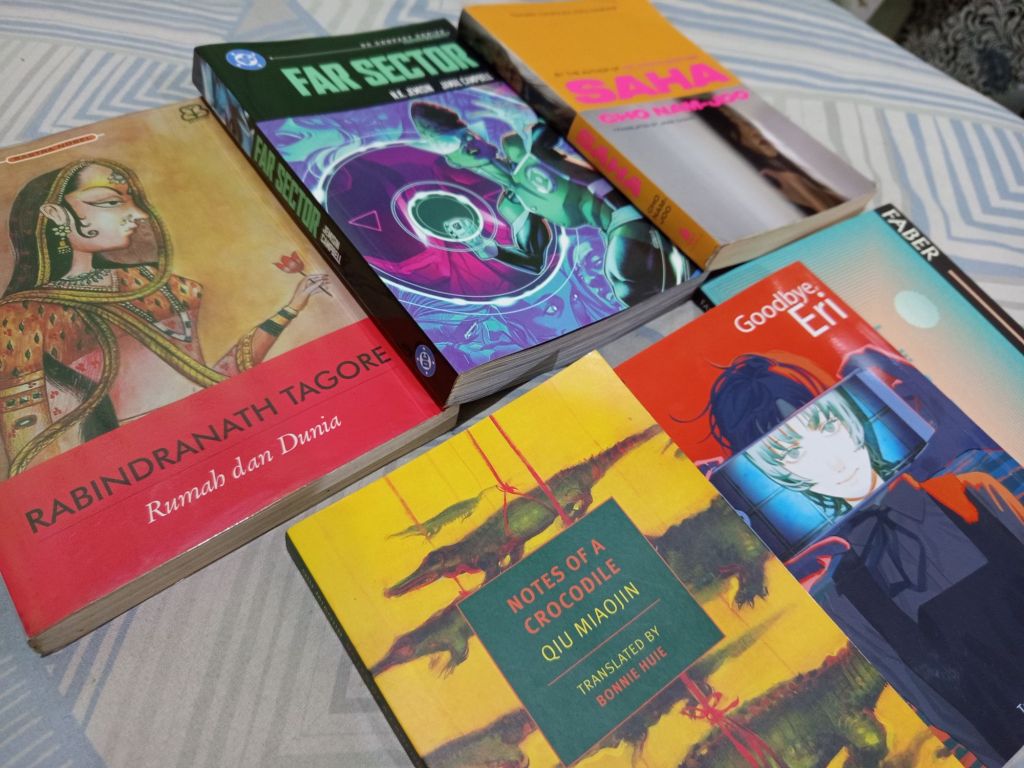
I am still reading some fiction to finish 2024. As I wrote this paragraph, I just finished Tiga Drama (2024) by Seno Gumira Ajidarma and Junji Ito’s Cat Diary (it’s super weird, but not Tatsuki Fujimoto weird). I am currently reading Belkin’s Stories & A History of Goryukhino Village written by Alexander Pushkin. Yet, I decided to conclude the list since it’s already half into December anyway.
I don’t read that much fiction this year. I am more inclined to catch up more non-fiction and academic literature, especially around language and cognition. One thing that stood up about my fiction reading list of this year is I get to read across the globe. From Papua New Guinea to Senegal, Argentina to France, Padang Pariaman to Kupang, it covers pretty much a lot of ground. Although, yes, not enough. I haven’t been fixated in one scene for years now and I am not planning to stop.
If any of you, my dear reader, has a recommendation on Northern Chinese, Burmese, Tibetan, Zambian, Cuban, or any literature from southern hemisphere, please reach me out. My social is in the bottom of this page. Hahaha.
So, here are the best five fiction I’ve read this year. Take it as a recommendation, reference, judgment, whatevs. Add a grain of salt for more umami flavor:
5. Parang Tak Berulu by Raudal Tanjung Banua

| Publisher | Gramedia Pustaka Utama |
| Year | 2005 |
| Language | Indonesian |
| Pages | 182 |
I am the kind of person that judge the book by it’s cover. And this cover is very particular and recognizable. The cover is a work from none other than Ong Hari Wahyu, one of my favorite book cover designer of all time! I like how the cover that Ong Hari Wahyu creates always capture the vibe of the stories within. Most of the time, they are not necessarily illustrative or representative like how many book covers are designed. Raw and incredibly emotive, and letting the author speaks through words instead. His book covers work more as an invitation.
Anyway, however you feel about the cover, I think it’s also how you felt about what’s inside. Raudal Tanjung Banua is a visceral writer, with some degree of conscious politics thrown; especially when he talked about the clash of civilizations in his stories.
His stories in this book confront the customary way of life of West Sumatran. A lot of it left lingering impression on me. Especially, the story titled Tubuh yang Bersekutu. There are not a lot queer stories in Indonesian literature, let alone the one with the particularly local setting, let alone the one without the homophobic tendencies. Yet, Tubuh yang Bersekutu is a proof that Banua is able to dance around the politics of old in traditional value and setting, with the personal is political adage of recent.
4. Simple Passion by Annie Ernaux

| Publisher | Seven Stories Press |
| Year | 2003 |
| Language | English |
| Pages | 67 |
The complication of relationship is incredibly human. The term ‘relationship’ in human vocabulary is altered in a way, that it transcends it’s ecological meaning. Annie Ernaux knows all of that too well. Her writings are awfully human and autobiographical. A whole corpus of justification towards desire. A written relationship that is bare and blurry; a stark imagery with vignette washes away details.
Simple Passion makes me think a lot about the nature of desire, and how to act on desire should be (im)properly weighted upon. There is a moral ramification of following one’s passion. Litigation world even has a phrase for it: a crime of passion. Yet, what if the crime is only to ponder further about human connection. Sex is a million times easier.
3. Dataran dalam Kobaran Api by Juan Rulfo

| Publisher | Gramedia Pustaka Utama |
| Year | 2021 |
| Language | Indonesian |
| Pages | 192 |
I wrote an entire essay on Juan Rulfo, due to my admiration of him as a writer. There are not a lot influential writers that only write a book or so in between decades. Harper Lee for one. This short stories collection, published in Spanish in 1953, expands the distinct writings of Rulfo: of his temporal structure and magic realism.
I am particularly fond of the story titled Mereka Telah Memberi Kami Lahan (Nos han dado la tierra). The story follows four protagonist, marching across a barren land given by the government as part of the land reform program. The utter desperation and defeatism showed in the dialogues, serve as an allegory of everyman’s confusion in the tumultuous political transition—especially regarding a policy that affects everyday life.
This collection features a myriad amount of suspense and violence, metaphorical and literal. So much anxiety and pessimism. A break from conventional storytelling structure. A masterclass of writing on a class of it’s own.
2. Cinta Terakhir Baba Dunja by Alina Bronsky

| Publisher | Gramedia Pustaka Utama |
| Year | 2020 |
| Language | Indonesian |
| Pages | 160 |
Baba Dunja somehow reminds me of Keiko Furukura from Sayaka Murata’s Convenience Store Woman (2016). The indifference towards seemingly the tragedy of humanity—stagnancy and mediocrity—is incredibly existential in nature. In Baba Dunja’s case, the indifference even seems more stark compared to her surrounding—or, the setting of the story: a post-nuclear-meltdown settlement in Tschernowo.
The ghost, the town interaction, and the familial relationship, and the murder, reminds me a lot of Albert Camus and Juan Rulfo. Somehow, Alina Bronsky makes the tale of an old woman in defunct town very interesting, existential, and full of suspense!

.five; Honorable Mention:
Pelajaran Membaca by Beri Hanna
| Publisher | Rusa Menjana |
| Year | 2023 |
| Language | Indonesian |
| Pages | 120 |
There are not a lot Indonesian writer that has developed their own écriture or langgam in their very young career. I know people who wrote books in a year and yet the writing is indistinguishable from other writers. But not Beri Hanna. When I found his absurd stories and his Jambi tongue in his stories, I immediately admire his style of writing. His stories are unconventional, and have a lot of room for improvement. He is yet to peak, and I am excited to see what he write next.
1. Bahaya Merokok di Ranjang by Mariana Enriquez

| Publisher | Labirin Buku |
| Year | 2023 |
| Language | Indonesian |
| Pages | 216 |
I applaud Gita Nanda for beautifully translating the intended vibe of Mariana Enriquez’s stories! The stories are dark and fantastic, as they should as they are psychological horror. I can think of three stories from this collection that impress me so much. I still think I am haunted by the image conjured by Enriquez’s words.
One of the story titled Sumur or The Well. This story follows Josefina, a ‘possessed’ young woman who has been haunted by ‘evil spirit’ since her visit to The Woman, an alleged witch. The story is not much of a traditional in ghastly fashion. The hypochondriac anxiety that Josefina feels is the real horror here.
Other story called Perempuan Tambang or Our Lady of the Quarry follows an extreme juvenile delinquency and bitterness. This story has a lot more in common with other horror stories and films featuring teenagers. And as they are all, this story also gets dark. Lastly, Anak-Anak yang Kembali or Kids Who Come Back that is straight horror and dystopian. This story reminds me of 9 (dir. Shane Acker, 2009), that Young Justice episode with Klarion, and Little Nightmares game franchise with the kids as the monsters.
My fiction reading list resolution for 2025 is that I need to further expand my literary knowledge to every crevices of the earth. I want to read a story from a slum in Bengaluru, I want to read a writing from a queer middle-school teacher in Iceland, I want to read a piece from disabled teenager in Fiji Island. I want to read more stories from the unheard corner of the world!
That desire is my fuel to build Puer Party Literary Magazine, which hasn’t been working on the first issue due several personal, well, issues.
I hope the magz launches no later than Q1 2025 though!
 Kasat Kata Kultur
Leave a comment