
First published in Indonesian on 2nd March 2024 for Balebengong, a Balinese online media with more than 18K following, under Sehabis Manis Manis.
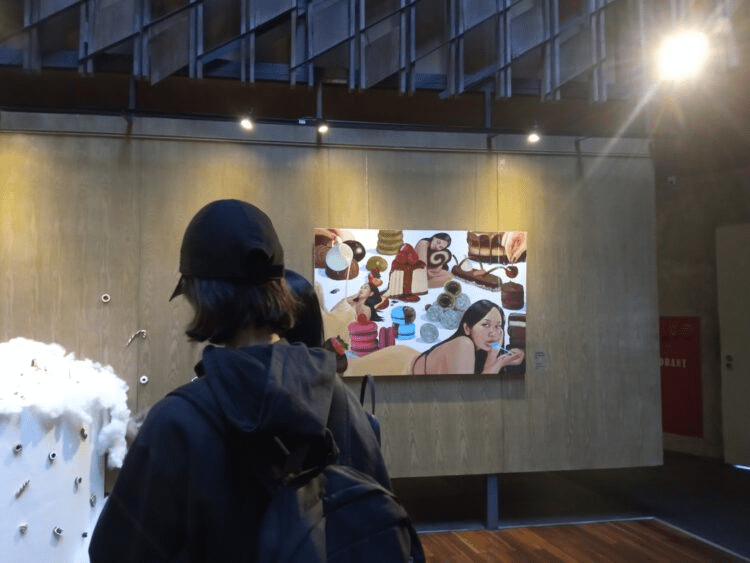
My friend Ruris cried as we entered the lobby of ARTOTEL Sanur, “That painting looks like a Katy Perry video clip!” I couldn’t have agreed more. The painting displayed in the lobby, which also serves as a gallery, reminded us of ‘California Gurls‘ sung by Katy Perry and Snoop Dogg. On September 1, 2023, the four of us visited Dayu Sartika’s solo exhibition, Manis Manis. Held at ARTOTEL Sanur, the exhibition ran from September 1, 2023, to November 14, 2023.
Manis Manis featured 12 paintings and one installation. Dayu Sartika, the artist, graduated from the Department of Fine Arts Education at Ganesha University of Education. Since 2020, she has begun to boldly depict herself, inspired by Frida Kahlo’s credo: “I am my own muse. I am the subject I know best. I want to know the subject better.” In her work, Dayu seeks to find harmony and self-discovery, while uncovering the mysteries of her own body.
“Welcome to my birthday party. I mean that.” That’s what Dayu said as she ushered in Manis Manis. In her artistic exploration, Dayu hints at a rebirth of herself. The rejection and desire depicted on her body on canvas are the ultimate paradox: while the canvas acts as a mirror of the self, it also represents resistance and inner turmoil to reject oneself. Like a mortal enemy, Dayu says.
Self-portraits become the central subject of diegetic (what is depicted on the canvas) discussions in the displayed works. They are juxtaposed with sweet treats, which are the embodiment of unfulfilled desires. These desires seem trivial in their typical form, yet in their signification, they constitute an extraordinarily steep and huge wall. As the artist stated at the opening of her exhibition, “In reality, I can’t eat sweets anymore because I was diagnosed with breast cancer in 2015. But in this series of works, I’m not just talking about the illness, but about life’s adversary in general. High expectations, uncontrollable emotions.”
Using one’s own body as a subject is a common practice among artists. In the most common aesthetic reasoning—and inevitably, within the confines of a patriarchal context—the (female) body is burdened with exotic meanings.1 Its interpretations are then multiple. Berger places this discussion through the lens of the male gaze.2 Feminist scholars have subsequently contributed their opinions, developing and providing critical notes on the concept of the male gaze itself.
The male gaze, as coined by Berger in 1972, refers to a way of viewing and interpreting the world that prioritizes the male perspective. This concept rests on the perspective of the heterosexual male viewer who actively controls the gaze, while women are positioned as passive objects of desire—where their bodies typically exist only to be gazed upon and admired. This dynamic reinforces patriarchal power structures by viewing women through the lens of male objectification and limiting women’s agency in visual culture.
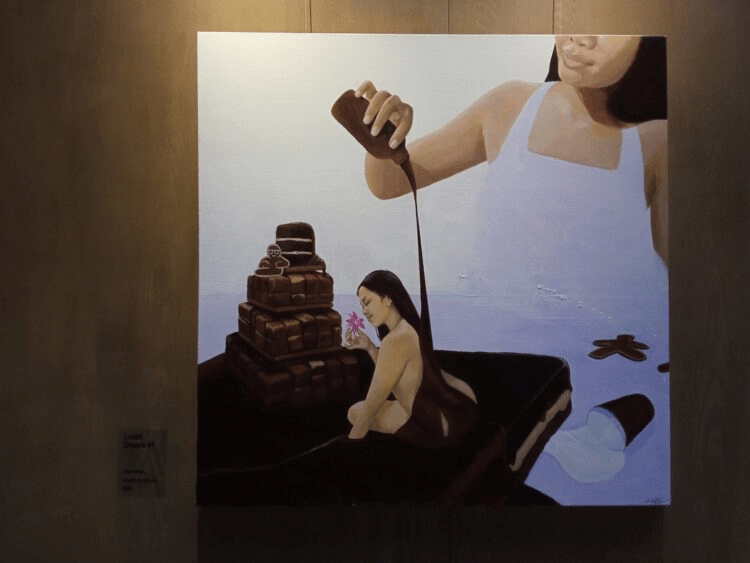
When paired with dessert, viewers impose yet another meaning on the female body. The explicit symbol of sweet treats as desire also carries an implicit meaning of objectification. ‘Sweet’ itself is an adjective often used when discussing femininity; an adjective that is considered oppressive in an androcentric context. ‘Treats‘ is merely a connotation, containing within it the meaning of ‘enjoyed‘, ‘eaten‘; a connotation that elevates the discussion of the subject to the issue of objectification.3 However, what if this interweaving of symbols were carried out by women themselves—as a representation of women’s experiences?
Of the 13 works on display, 12 use the female body as the subject and Dayu Sartika’s self-portrait as the artist. The absence or limited shroud or coverage of the subject could mean two things. First, a subversion of norms—and this, excitingly, brings the discourse of women’s liberation within the feminist tradition. Second, a celebration—of the body and a conversation beyond desire. This dual meaning is not diametrically opposed; it is a paradox that is equally valid. Anger as an intent for subversion and joy as the root of celebration naturally coexist.
These self-portraits certainly challenge the discourse of the male gaze. The body is not simply depicted. Another signifier enters through the dessert—and is elaborated upon in the accompanying paratext—in the form of the artist’s statement about dietary taboos as context. The male gaze perspective is annulled because exotic discussions about the body cannot be separated from discussions about desire, depicted through the Imaginary (images and representations) and the Symbolic (language and social roles).4 Thus, the self-portraits in Dayu’s works represent her attempt to reclaim her body and sexuality from the male gaze.5
Interestingly, the attempt to reclaim the body in Manis Manis‘ works is an explicit effort, elaborated within the context—and conveyed by the artist herself. By disregarding the male gaze from its very intention and aspiration, and emphasizing that the claim to one’s body is solely hers, men are excluded from the discussion from the outset. Manis Manis then becomes an exhibition of feminist works in toto, wholly and entirely.
However, there is one separate work that “does not submit” to the theme that has been discussed at length. The painting, titled “Ready to Eat #3,” simply depicts three slices of cake, one in white and one in brown. The 30 x 40 cm painting also features typography that reads “Where’s my Dessert?” The subject of this cake, in fact, becomes a piece of artwork that amplifies the theme throughout Manis Manis‘ work. This work is interesting because it lacks the artist’s oneself as the subject, but instead carries a weight of meaning that encapsulates, echoes, integrates, and completes Manis Manis‘ catalog. How so?
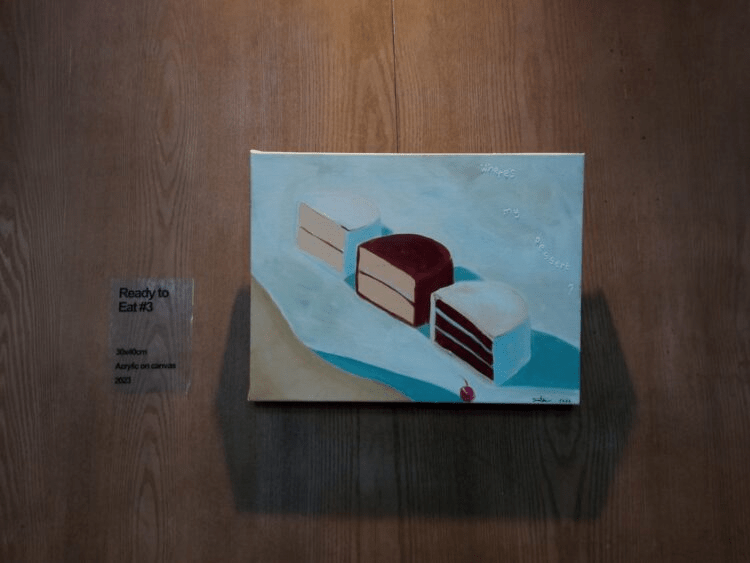
The loss of the self-subject can be interpreted in two ways: transcendence and an emphasis on desire as a theme. Transcendence is the simplest—the Imaginary is assumed to transcend the human. The subject manifests in the form of human will (in the form of a cake) but stands without human representation. Human traces remain in the typography in the form of questions—about taboos, demands, and the pressure of desire to violate them, paralleling how humans become in mythology. As in creation mythology, the khuldi, apple, and cake occupy the same position in this painting. Transcendence, then, is not merely about the absent (or unstated) self-subject, but the parallels in reasoning about desire manifested across mythologies.
Certainly, cake becomes an overly personal subject when juxtaposed with the context of Dayu’s struggle with breast cancer. The taboo on eating sweet treats becomes a discourse of demands to discuss herself. Repressed desires become a major theme. Sweet treats then become a symbolic motif to tense up the issue of desire.6 In semiotic reasoning, the interpretation of sweet treats is simply a representation of pleasure and comfort. In cultural typology, desserts become a pathway for maternal bonding, usually with fruit. Comfort and pleasure are then challenged, with Ready to Eat #3 and the absence of Dayu, creating a tension between desire and denial. The self-subject here distances itself from the material subject, underscoring the tension between the struggle against pain on both the emotional and physical levels. If Dayu likens her mind to a plaything, then this play carries its own inherent violence.
Returning to the context of patriarchal and androcentric culture, desserts have their own typical symbolic meanings. As in Katy Perry’s music videos and cartoons like The Amazing World of Gumball (2011-) and Adventure Time (2010-2018), sweet treats are always associated with femininity. Femininity is easily depicted through the pleasure and desire represented by candies and cakes. Sugar and honey are natural terms that have historically been reserved for women endearment. In the androcentric field, sugar—literally7—is interpreted as a desire that must be repressed. Sugar becomes an adjective to describe the ideal body, but a noun to be avoided in order to achieve that ideal body itself.
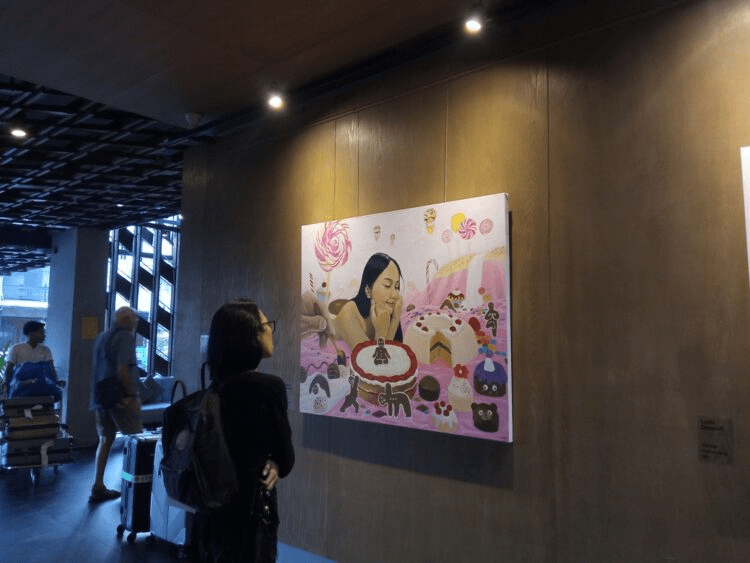
However, Dayu challenges all of these established male meanings. By using sweet foods, Dayu places stereotypes in tension with their typical meanings. The juxtaposition of the self and the material subject works to echo an alternative meaning: that desires should be celebrated, even if conditions do not permit their fulfillment. Ready to Eat #3 then doubles down on its alternative meaning, leading the juxtaposition of Manis Manis‘ work and re-embodying the relationship between sweet treats and the self.
- Butler, Judith. 1990. Gender Trouble: Feminism and the Subversion of Identity. Routledge. ↩︎
- Berger, John. 1973. Ways of Seeing. BBC dan Penguin Books. ↩︎
- Korsmeyer, Carolyn. 1995. Making Sense of Taste: Food and Fine-Dining Culture. Cornell University Press. ↩︎
- In Lacanian terms, sweets can represent the Real, a realm of pre-linguistic (before-language) desire and pleasure that is forever elusive. The desire for sweets symbolizes the impossible attempt to attain the Real through the Imaginary, i.e., the image of sweets in paintings, and the Symbolic, i.e., patriarchy and its excesses such as the male gaze and the binary division of gender roles. For more information, see Leader, Darian, et al. 2000. Introducing Lacan. Icon Books. ↩︎
- Mulvey, Laura. 1975. Visual Pleasure and Narrative Cinema. Routledge. ↩︎
- Bordo, Susan. 1993. Unbearable Weight: Feminist Theory and the Body. University of California Press. ↩︎
- John Harvey Kellogg, the inventor of corn flakes and cereal—an Adventist himself—believed that eating bland foods would help tame desires and prevent people from indulging in their lower instincts. He also believed that masturbation was the source of chronic disease. As reported by Braun, Whitny. 2017. How the Seventh-Day Adventist Church Gave You Breakfast Cereal: You’re Welcome. Huffington Post Blog. ↩︎
 Kasat Kata Kultur
Leave a comment