
First published on 28 August 2023 for Tatkala, northern Balinese publication under Batas Nalar : Catatan Sehabis Menonton “Our Sea is Always Hungry” – Leyla Stevens.
Raised in a tradition of literacy as strict as my religious upbringing, I have long experienced contradictions. My limitations as a child and a human being, curious about the meaning of my existence in the world, have left me plagued by differing values. This is because what I found in books differed from the words and hands of my parents, especially my father. It was strange, considering who else could provide those libraries but him. One of the values my father tried to pass on, yet fraught with contradiction, was the morality and ideology at work within them.
In my father’s defense, 1965 was a sin committed by the wicked communists. This rhetoric was repeated by those around me at the time, who often put holy books above others.1 Now I understand why he could say that. Despite having spent his early adult life selling books, he apparently also suffered from the fear born of diligent religious study. Thus, I inherited his legacy of contradiction.
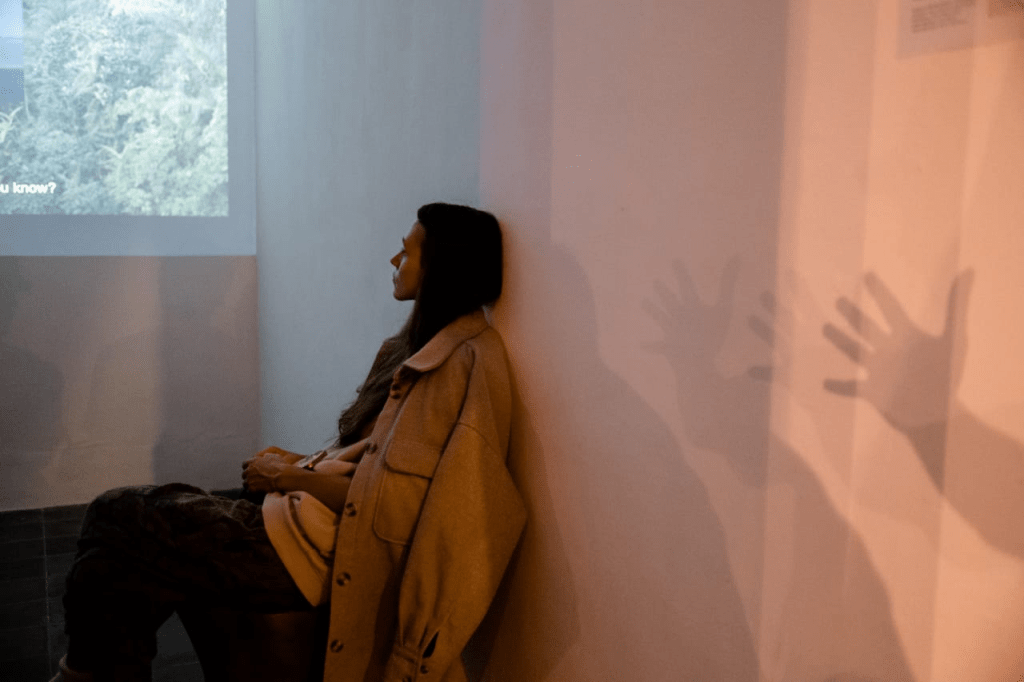
“The struggle of man against power is the struggle of memory against forgetting,” Milan Kundera’s words in The Book of Laughter and Forgetting2 remind us that history written by the powerful is a history that seeks to erase the memory of events. For power to endure, stories must be literally passed down through the throne.3 Mere one story, no other.
Thus, throughout my young adulthood, I have been faced with the effort to unlearn what my father bequeathed. I have read and written many responses and articles about 1965. Our Sea is Always Hungry (Leyla Stevens, 2018), on view at Cush Cush Gallery in August 2023, is no exception. However, I was moved to rethink the meaning of boundaries that I intended to discuss in this essay.
Leyla Stevens, through her audio-visual work, presents various b-roll footage with post-production stylization. Accompanied by a heartbreaking and poetic narrative dialogue, Our Sea is Always Hungry literally depicts the tug-of-war between boundaries. It opens with an image and story of a sea line separating two geological reefs, later called the Wallace Line by colonial scientists, defining the boundaries between what can grow and develop between them. The work begins with a story that de-centers humans, then draws into the story of humanity and its inherited trauma.4
The female voice in the narrative challenges the violence occurring on the land along these two lines as being more ancient. She challenges colonialism while reminding us that the riots began with seven bodies in a hole, a point later drawn by the male voice that all of this began in 1963. The dialogue then re-examines the boundaries between civility and barbarity, with a horror story about how the “butchers” always decided to drink palm wine after killing off suspects—as if celebrating the deaths of innocents. One—later recognizing himself as a farmer—managed to escape the slaughter and decided to withdraw from civilization because of it.
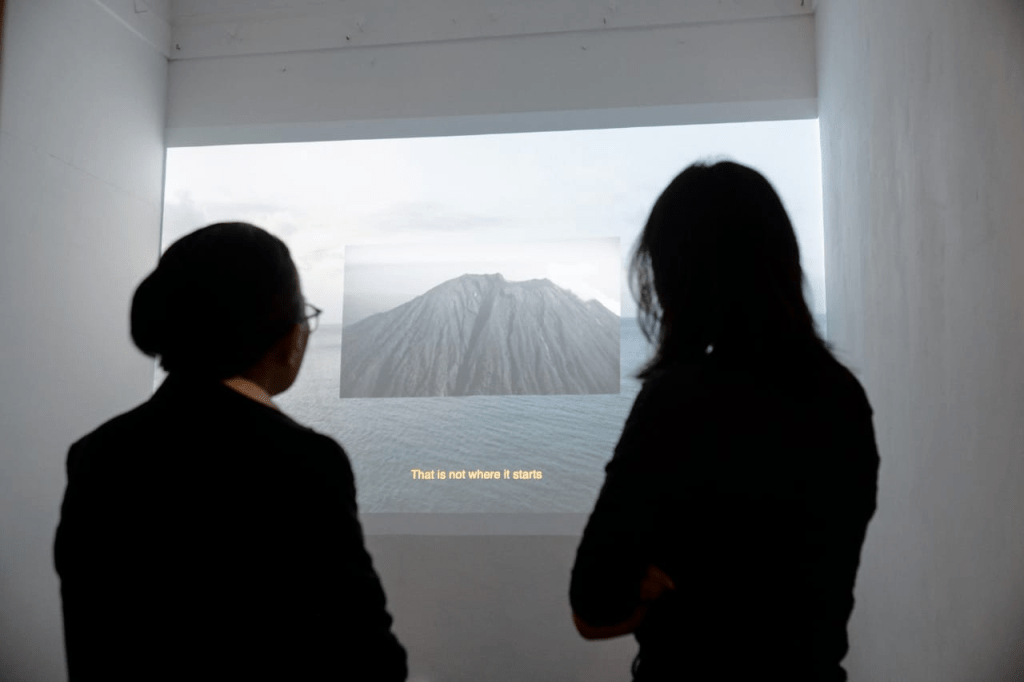
The farmer’s days are then overshadowed by Wong Samar, while he carries the guilt of survival. Wong Samar, as the embodiment of this guilt, is sometimes invisible and sometimes visible, while the farmer also decides to emerge and disappear within the realm of civilization. His memory then also becomes something invisible or invisible.
The agenda Leyla Stevens brings to this work is clearly layered. Memory—or should we call it history—an alternative that presents tragedy as a human disaster becomes blurred because it is presented as a work of art within a taboo and incredibly hegemonic conversation. This work maps the boundaries of many things. More importantly, this work then transforms into affective material—simply put, a monument to which people can attach all their empathy and emotion through its discourse.
Borders, say mestiza scholars5, are spaces of becoming. The interiority (consciousness as subject) of the “I” intersects with the interiority of the “you.” This intersection of interiorities manifests as exteriority (consciousness as subject-in-the-world, or dasein in Martin Heidegger’s term6), which gives birth to self-culture.7 This exteriority occurs in physical or socio-spatial spaces that are performative, manifesting as monuments or acts—or affective materials. In this work, Our Sea is Always Hungry becomes a hook for its performative spatiality in art exhibitions.
It is important to understand that boundaries are the result of modern reasoning, which views both poles as clashing extremes. This same modernism gave rise to state violence and the end of the old colonialism. Therefore, the antidote in the form of after/post-modernism gradually offers a spectral worldview, befitting the shape of the globe and the universe.
In relation to memory, this new perspective on boundaries offers a way to challenge it by viewing memory or history as an overly personal consequence. Visually, it blurs the boundaries between violence and its impact in the duotone stylization at the end of the footage. Trauma speaks to everything, even to the impact of its reasoning, which can be interpreted as magical or psychotic at the end of the story.
I am, vaguely, the person who perhaps least recognizes “boundaries.” Not only because I am “insolent” in the eyes of my elders—my mother nicknamed me “Bima” because of it—but also because I have never fully recognized “boundaries.” I have “lived” in eight cities in my 27 years of life, so I have never truly absorbed the identity of a Jakartan, or Makassarian, or Ngawizen, or Jogjanese.
Then, I offer myself to see myself as a citizen of the entire universe and boldly transcend boundaries. I re-reason the memories I have acquired and invalidate them. Through the eternal hunger of the sea8, Leyla Stevens offers me a mirror: to surrender myself to the spectrum and to live on because every head is a monument. The wounds and beaming instability are its foundation. Perhaps.
- The link between religious fundamentalism and the fear of communism is apparently a global phenomenon. If you want to learn more, you can read Bennett, Jeffrey S., “The Blue Army and the Red Scare: Politics, Religion, and Cold War Paranoia.” Politics, Religion & Ideology 16.2-3 (2015): 263-281. ↩︎
- Kundera, Milan, 1979. Kniha smíchu a zapomnění or The Book of Laughter and Forgetting. ↩︎
- This is one of the Machiavellian tactics outlined in Il Principe (1532). ↩︎
- The footnotes to this section should be read after the entire essay. This section raises the question: does anthropocentrism also concern the issue of memory? Are memory and history uniquely human, or do they transcend them? What about memories that are uprooted by the impact and politics of memory, so that they must then be placed through a point of view beyond the human—as in this work, the sea and the trees, for example? ↩︎
- Anzaldúa, Gloria (1987), Borderlands/La Frontera: The New Mestiza. San Francisco: Spinsters/Aunt Lute. Or you can read one of the reviews—along with a border talk—here: Hybridity and Performativity. ↩︎
- If you have a lot of free time, you can read Sein und Zeit/Being and Time (1927) by Martin Heidegger. If you have a little more free time, you can read Heidegger and the Mysticism of Everydayness (2016) by F. Budi Hardiman or Heidegger: A Graphic Guide by Jeff Collins and Howard Selina. ↩︎
- Channing, William Ellery. Self-culture: An introductory address to the Franklin lectures, delivered at Boston, September 1838. Vol. 9. No. 6. Dutton and Wentworth, printers, 1838. ↩︎
- Our Sea is Always Hungry (Leyla Stevens, 2018) is a 13-minute, 16-second single-channel video work with stereo sound that explores the visual language of documentary and fiction. An investigation into the lingering and supposedly forgotten events of 1965 in Bali is the subject of this work. This work is exhibited in Sang Gunung Menyerahkan Jejaknya ke Laut (CushCush Gallery, 2023). This footnote is placed at the end so that readers are not ‘contaminated’ by Leyla Stevens’s authorship as an artist, or this essay as a response. ↩︎
 Kasat Kata Kultur
Leave a comment